
Webinar Series: Scaling Up Sustainability for MSMEs Through Innovation and Collaboration
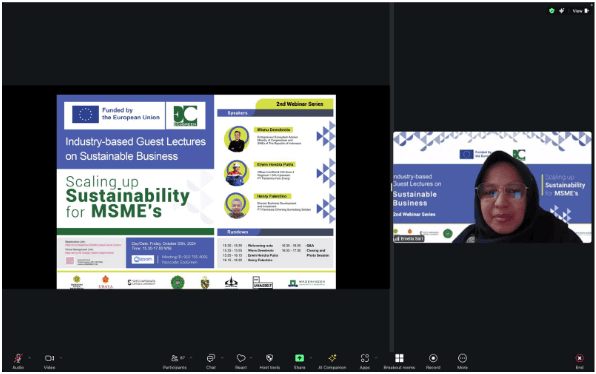
As part of its continued commitment to advancing sustainable entrepreneurship, the Erasmus+ ECoGREEN Project successfully held the second webinar series of Industry-based Guest Lectures on Sustainable Business, titled “Scaling Up Sustainability for MSMEs”. The webinar attracted 257 participants, including students, lecturers, SME practitioners, professionals from partner universities, and representatives from government institutions, reflecting strong interest in sustainable business transformation across sectors.
The session featured three distinguished speakers from government, industry, and community-based enterprise sectors, each presenting practical perspectives on how sustainability can be integrated into MSME development through policy, innovation, and collaborative ecosystem building.
Wisnu Dewobroto, Entrepreneur Ecosystem Advisor at the Ministry of Cooperatives and SMEs of the Republic of Indonesia, delivered a keynote on “Policy and Empowerment Ecosystem for Sustainable MSMEs.” He emphasized that entrepreneurship remains one of Indonesia’s main economic drivers and highlighted the government’s vision of balancing economic growth with social and environmental responsibility. According to him, the future of Indonesian entrepreneurship lies in empowering younger generations to build innovation-driven, research-based, and sustainability-oriented ventures. He also stressed that sustainable entrepreneurship should not only focus on business efficiency, but also on creating measurable positive social and environmental impact.
Providing an industry perspective, Erwin Hendra Putra, Community Relation and CID Officer at PT Pertamina Hulu Energi, shared the inspiring case of GEMILANG PLUS (Gerakan Perempuan Lestarikan Alam melalui Konservasi Pinang) under the topic “Energy Sector MSMEs: Integrating Sustainability in Operations.” The initiative empowers women in Sukakarya Village by transforming locally abundant areca nut resources into innovative eco-friendly products, including herbal beverages, biodegradable materials, eco-print crafts, and corrosion inhibitors. Beyond creating sustainable products, the initiative has generated measurable socio-economic and environmental impact, including increased household income, community empowerment, and the planting of 14,000 areca seedlings to strengthen local conservation efforts.
The webinar also highlighted sustainability in tourism entrepreneurship through a presentation by Henry Falentino, Director of Business Development and Investment at PT Pariwisata Ciherang Sumedang Selatan, on “Tourism MSMEs and Local Sustainability Practices.” He introduced the Industri Desa Industri (IDI) initiative, a village-based labor-intensive development model that actively engages local communities in inclusive economic growth. Henry emphasized the importance of sustainable tourism through the 3A framework—Attraction, Accessibility, and Amenities—as a strategic approach to maximize local potential while ensuring long-term environmental and community benefits.
Throughout the session, participants gained valuable insights into how sustainability in MSMEs can be scaled through innovation, technological adaptation, inclusive business models, and strong multi-stakeholder collaboration involving government, academia, industry, and local communities. Real-world examples shared by the speakers demonstrated that sustainability is not merely an environmental agenda, but also a pathway toward economic resilience, social inclusion, and long-term community empowerment.
This webinar series further strengthens ECoGREEN’s mission to foster green entrepreneurship education and build a sustainable business ecosystem capable of creating meaningful impact for communities, industries, and future generations.